
Starting at 34 TH/s: What the Numbers Say
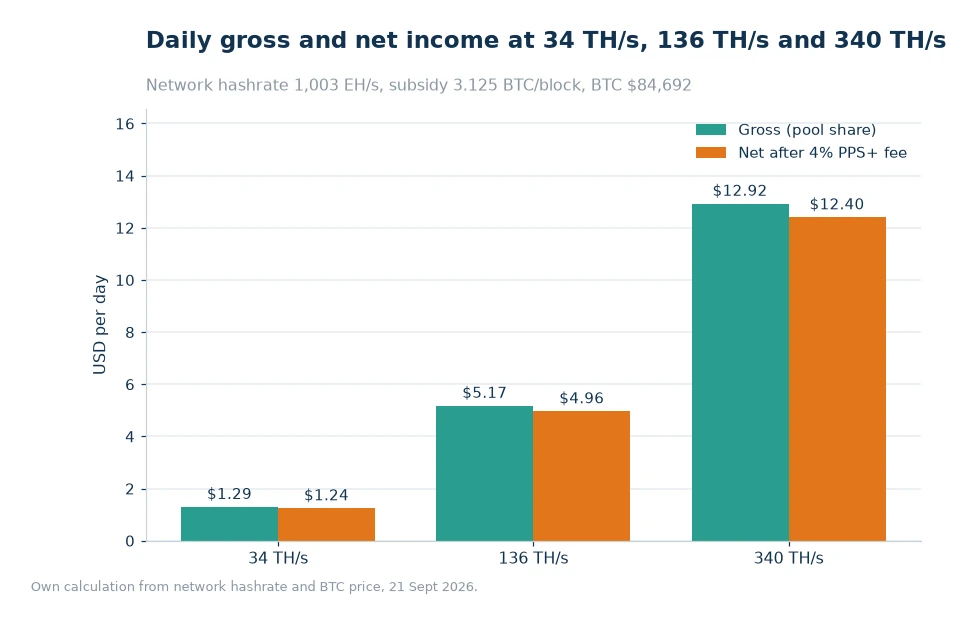
A first rig does not need a large hashrate to be worth understanding, but it does need honest arithmetic. At 34 TH/s, current conditions produce 1.525e-05 BTC a day, worth $1.29 at $84,692 per BTC, or $1.24 after the listed 4% on the block-reward component. At that size, fixed costs matter more than the pool rate.

Key takeaways
- At 34 TH/s, daily output is 1.525e-05 BTC, or $1.29 gross and $1.24 net of the listed 4% on the block-reward component.
- At 340 TH/s the same inputs give 0.00015253 BTC a day, $12.92 gross and $12.40 net.
- Fixed costs such as a power supply, a meter or a cooling fan can exceed a small rig's daily margin.
- PPS+ pays hourly against current difficulty; PPLNS pays after 6 confirmations across the last 5 difficulty rounds.
A small start is still an arithmetic decision
The appeal of a small rig is that the downside is bounded. That is true of the capital at risk, but it is not true of the operating cost. A 34 TH/s machine still needs a power supply, a network connection, a cool room and someone to notice when a fan fails. Those costs do not shrink in proportion to the hashrate, so the smallest setups often carry the highest cost per terahash.
That does not make a small start a mistake. It makes the arithmetic more important. A miner who knows the daily gross, the listed charge and the power cost before buying can see whether the rig is a hobby with a known cost or a small business with a thin margin. Both can be reasonable, but they should not be confused with each other.
The formula on three lines
Daily output needs three numbers: your hashrate, the network hashrate and the daily issuance. At 1,003 EH/s and 3.125 BTC per block across 144 blocks, the network issues 450 BTC a day. Your share is 34 divided by 1,003,000,000, and that share times 450 BTC is the daily gross. The BTC price then converts the coin figure into dollars.
The ViaBTC Bitcoin Mining account applies the payout method. PPS+ is the default, settling hourly against current difficulty with a listed 4% on the block-reward component and a listed 2% on the transaction-fee component. PPLNS combines both and carries a listed 2%, with settlement after 6 confirmations. For a 34 TH/s rig, either method produces a small daily figure, so the timing difference is less important than the total cost of running the machine.
What 34 TH/s can and cannot do
The table steps from one small unit to four and then to ten. The scaling is linear, so the middle row is four times the first and the top row is ten times the first. The net column applies the listed 4% to the block-reward component and leaves out power, which is the cost that decides whether the smallest row is viable.
| Hashrate | BTC per day | Gross USD per day | Net USD per day |
|---|---|---|---|
| 34 TH/s | 0.00001525 | $1.29 | $1.24 |
| 136 TH/s | 0.00006102 | $5.17 | $4.96 |
| 340 TH/s | 0.00015253 | $12.92 | $12.40 |
At the first row, a month of net income is about $37.20 before power. That is the entire budget for electricity, cooling and any replacement part. A single fan can consume several months of that margin, which is why small miners should treat hardware reserves as part of the plan rather than as an emergency. The top row is more comfortable, but it is ten machines, not one.
The fixed costs that dominate a small setup
Power is the largest variable cost, but it is not the only one. A dedicated circuit, a meter, a fan, a shelf and a network drop are all fixed or stepwise costs. At 34 TH/s they can outweigh the pool charge by a wide margin. The listed 4% on the block-reward component is about $0.05 a day at this size, while a cheap fan replacement might cost more than a month of that charge.
The right way to account for them is to add a monthly fixed-cost line to the worksheet and divide it by 30. If the fixed line is $10 a month, it is $0.33 a day, which is more than a quarter of the $1.24 net at 34 TH/s. That single line changes the decision far more than a small change in the listed rate. Keep the fixed costs visible and the variable ones follow.
When to scale to 136 or 340
Scaling makes sense when the fixed costs are already paid and the marginal machine covers its own power with a margin. Moving from 34 TH/s to 136 TH/s adds three units, but it may not add three new circuits or three new fans. If the infrastructure has room, the marginal cost per unit is lower than the first unit's cost, and the net figure improves faster than the hashrate.
The next difficulty estimate is minus 2.12%, which would lift output per terahash slightly if it holds. Treat that as a small tailwind, not a reason to scale. The stronger reason is a power supply and a room that can carry more machines without a step change in overhead. Scale into spare capacity, not into a new fixed-cost tier, unless the larger tier is clearly covered by the larger payout.
Worked example
Take 34 TH/s and follow the chart arithmetic with the inputs read on 21 Sept 2026.
- Daily BTC per TH/s is 450 divided by 1,003,000,000, which equals 4.4865e-07.
- Multiply by 34: 4.4865e-07 times 34 equals 1.5254e-05 BTC, shown as 1.525e-05.
- Multiply by the BTC price: 1.5254e-05 times $84,692 equals $1.29 gross.
- Apply the listed 4% to the block-reward component: 4% of $1.29 is $0.05, leaving $1.24 net.
- Multiply by four for 136 TH/s: 0.00006102 BTC, $5.17 gross and $4.96 net.
- Multiply by ten for 340 TH/s: 0.00015253 BTC, $12.92 gross and $12.40 net.
- Thirty days at 34 TH/s nets about $37.20, which is the figure the fixed costs have to fit inside.
Watch the rig from the same account
A small setup benefits from keeping the payout and the hardware status in one place. The ViaBTC App shows hashrate and alerts on a phone, which is useful when the rig sits in a spare room and nobody is watching it during the day. A drop in hashrate is easier to catch early than a change in the monthly total, because the monthly total hides a bad week inside a good one.
Use the alert as a prompt to check the physical machine, not as a substitute for the arithmetic. The daily figure still comes from the formula, and the fixed costs still come from your own records. Together they tell you whether the first rig is covering its keep or quietly consuming the margin that was meant for the next one.
Frequently asked questions
Is 34 TH/s too small to be worth running?
It can be worth running if the power is cheap and the fixed costs are already paid. At current inputs it produces $1.24 net a day before power, so the answer depends on the local electricity rate rather than on the hashrate alone.
How much does the listed pool fee cost at this size?
About $0.05 a day at 34 TH/s, based on the listed 4% applied to the block-reward component. At 340 TH/s the same rate costs about $0.52 a day, because the charge scales with output.
Should a first rig use PPS+ or PPLNS?
PPS+ gives hourly settlement against current difficulty, which is easier to track in a small budget. PPLNS carries a listed 2% on both components combined but pays after 6 confirmations, so the timing is lumpier.
Know the fixed cost before the next rig
Write the daily net, the monthly net and the monthly fixed cost on three lines. At 34 TH/s that is $1.24 a day and about $37.20 a month before power. If the fixed line is small, the rig has room to grow. If it is large, the next dollar is better spent on efficiency or on a location with cheaper power than on another machine.
Sources: the ViaBTC homepage for the pool setup and the fee schedule for the listed 4% and 2% rates. Network hashrate 1,003 EH/s, difficulty 132.76 T, subsidy 3.125 BTC per block, 450 BTC daily and BTC $84,692 were read 21 Sept 2026, published 22 Oct 2026[1]. Every dollar figure is arithmetic on those inputs and moves when they move.